2026. 7. 29. 20:43ㆍKorea Food & Travel Guide
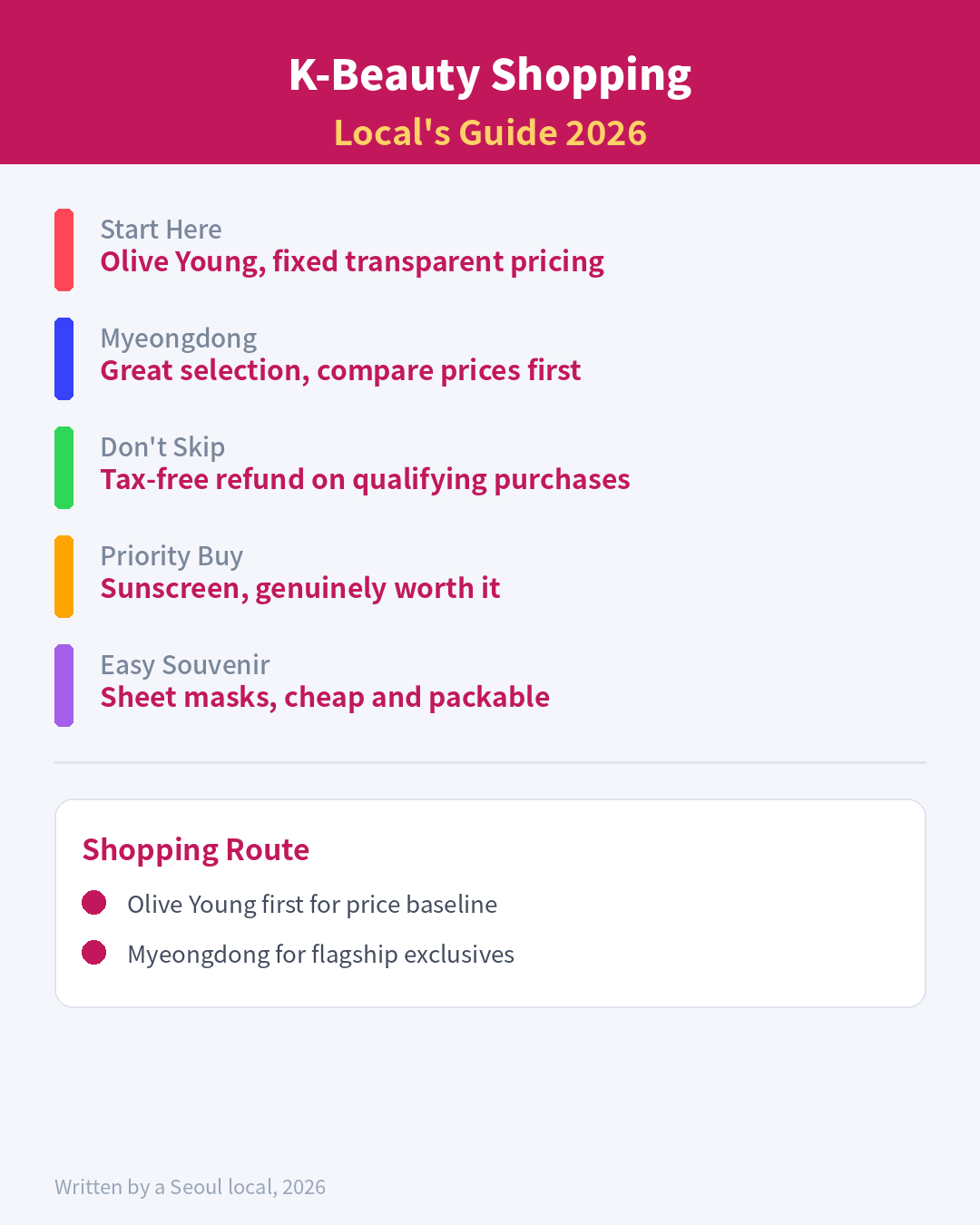
I get asked for skincare recommendations more than almost anything else when friends visit, and the honest answer surprises people: you don't need a curated list of "must-buy" products so much as you need to know where to shop and how pricing actually works here, because both are genuinely different from what most visitors expect walking in.
The Three Shopping Tiers
Multi-brand drugstore chains — Olive Young is the dominant player by a wide margin, with locations seemingly on every other block in shopping districts, alongside smaller competitors like Lalavla. These stock dozens of Korean brands side by side, run frequent promotions, and are genuinely the best starting point for browsing broadly rather than committing to research in advance.
Single-brand flagship stores — Brands like Innisfree, Etude, and others operate their own standalone stores, particularly concentrated in Myeongdong. These tend to have deeper product ranges for that specific brand and sometimes exclusive items not carried in multi-brand stores.
Department store beauty floors and duty-free — Higher-end Korean and international skincare, generally priced at a premium versus the drugstore tier, aimed more at gift purchases or luxury lines than everyday shopping.
For a first visit, start with Olive Young. It's the closest thing to a one-stop overview of the current Korean skincare landscape.
Myeongdong: Famous, But Know What You're Walking Into
Myeongdong remains the single most concentrated skincare shopping district in Seoul, and for good reason — the density of brand flagship stores and multi-brand shops here is unmatched. But it's worth knowing this going in: Myeongdong street-level sales staff are notoriously aggressive, often calling out free sample offers to pull you into stores, and prices at some smaller Myeongdong-specific shops can run higher than the same products elsewhere, banking on tourist unfamiliarity with standard pricing.
This doesn't mean avoid Myeongdong — the selection is genuinely excellent — but comparison-check a product's price at an Olive Young location (which has fixed, transparent pricing) before assuming a Myeongdong storefront price is standard.
Tax Refunds: Don't Skip This
As a foreign tourist, you're eligible for a VAT refund on purchases over a minimum threshold at participating stores (look for "Tax Free" signage, which most skincare retailers catering to tourists display prominently). The process: shop at a participating store, request the tax refund form and receipt at time of purchase, then process the refund at the airport before departure (or sometimes instantly in-store, at select "Tax Free" partnered locations, with a smaller convenience fee). This can meaningfully reduce the cost of skincare purchases and it's a surprisingly common oversight among first-time visitors who don't ask about it at checkout.
What Locals Actually Buy (Versus What Gets Marketed to Tourists)
A lot of tourist-facing skincare marketing pushes specific "hero" products or brands hard, but Korean skincare shopping habits among locals tend to be more ingredient- and routine-focused than brand-loyal:
- Sunscreen is treated as completely non-negotiable daily skincare here, far more so than in a lot of other countries, and Korean sunscreen formulations (particularly the lighter, less greasy chemical filters common in local products) are a genuine point of pride in the industry. If you try one Korean skincare category while visiting, this is the one worth prioritizing.
- Toners and essences as a layering step, not an occasional extra — the multi-step "layering" approach commonly associated with Korean skincare abroad is a real, mainstream local habit, not a marketing invention, though most locals' actual routines are simpler than the elaborate "10-step" versions popularized internationally.
- Cushion foundations (a compact-style liquid foundation applied with a sponge) are a genuinely Korean-originated product category and still widely used locally, worth trying if you're curious about a product type that's less common outside Korea.
- Sheet masks are cheap, widely available, and treated as a casual, frequent-use item rather than a special occasion product — a good, low-commitment souvenir to bring home in bulk given how inexpensive they are per unit.
Navigating Ingredient and Skin-Type Advice
Olive Young and most brand flagship stores have staff who can offer basic skin-type guidance, though language can be a barrier at smaller stores — larger flagships and Olive Young's bigger locations in tourist-heavy areas are more likely to have some English support. If you have specific skin concerns (sensitivity, acne-prone skin, etc.), it's worth looking up a few Korean ingredient terms in advance (many product labels list ingredients in both Korean and English, particularly at larger retailers) rather than relying entirely on in-store guidance.
Price Expectations
Korean skincare has a reputation abroad for being significantly cheaper than equivalent international brands, and this holds up reasonably well for mid-range drugstore-tier products, though it's less dramatically true than online forums sometimes suggest — some categories carry a real premium even locally, and imported or luxury Korean lines aren't necessarily bargain-priced just because they're Korean. Multi-brand stores like Olive Young run frequent sales and promotions (buy-one-get-one deals are common), so timing a purchase around an active promotion, rather than buying at full price on day one, can meaningfully change the value proposition.
A Realistic Shopping Route
If you want an efficient version of this rather than wandering: start at an Olive Young location to get a broad sense of current products and pricing, note anything that interests you, then head to Myeongdong for flagship-store-specific items or exclusives, comparison-checking pricing against what you saw at Olive Young. Save duty-free or department store purchases for higher-end lines you specifically want, rather than starting there.
Packing and Bringing It Home
Korean skincare products generally travel well in checked luggage, though liquids in carry-on need to comply with standard airline restrictions (typically under 100ml per container). If you're buying in bulk — a genuinely common tourist habit given the price and quality — consider whether checked luggage capacity, rather than airport tax-refund logistics, ends up being your actual limiting factor.
Written by a Seoul local. Store locations, specific promotions, and tax-refund thresholds are current as of 2026 but change regularly — confirm tax-free eligibility and current promotions at the point of purchase.